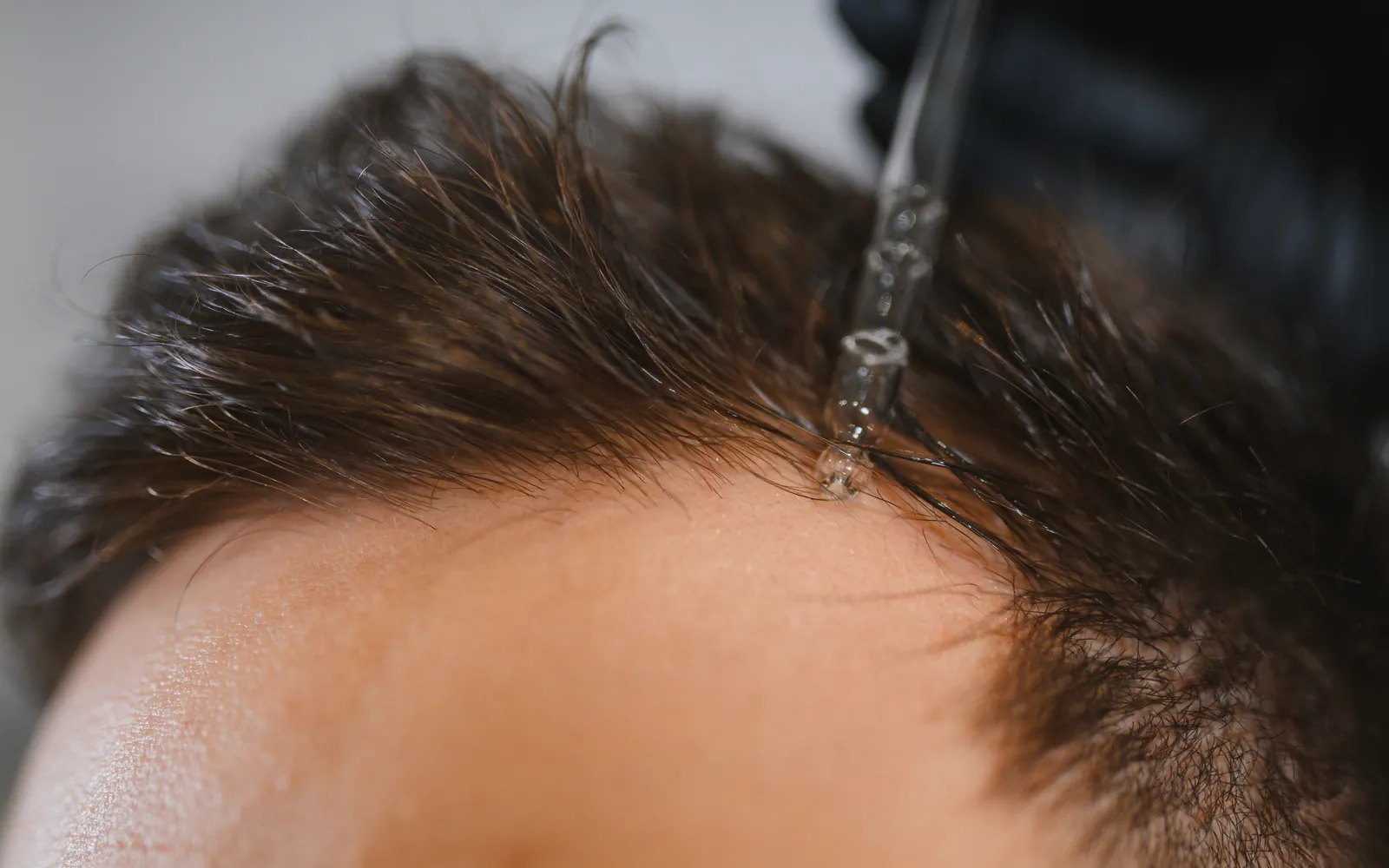
Male pattern baldness (androgenetic alopecia) is the most common cause of hair loss in men. It usually starts with a receding hairline at the temples or thinning at the crown and progresses slowly over years, in a recognisable pattern. It is caused by a combination of genes and the hormone dihydrotestosterone (DHT). It is not caused by wearing hats, washing your hair often or using hair products.
Genetics and DHT: how hormones affect hair loss
Testosterone is converted into DHT by an enzyme called 5-alpha reductase. In people with a genetic sensitivity, DHT binds to hair follicles on the top of the head and gradually makes them smaller, a process called miniaturisation. Each new hair grows back thinner and shorter, until the follicle stops producing visible hair.
Men with pattern baldness usually have normal testosterone levels. What differs is how sensitive their follicles are to DHT, and that sensitivity is inherited. The genes come from both sides of the family, not only from your mother’s father, which is why your father’s and your grandparents’ hair can both give clues.
Other hormones can play a part too. Anabolic steroids and testosterone supplements can speed up pattern hair loss in men who are prone to it. Thyroid disorders cause more diffuse thinning. In women, hormonal changes after pregnancy, around the menopause or with polycystic ovary syndrome can affect hair, usually as thinning across the top rather than the male pattern.
The Norwood scale explained, stage by stage
Doctors use the Norwood scale (also called the Hamilton-Norwood scale) to describe how far pattern hair loss has progressed. It helps with planning and with estimating how many grafts a hair transplant might need.
| Stage | What it looks like |
|---|---|
| Norwood 1 | No significant recession; a full, adolescent hairline |
| Norwood 2 | Slight, even recession at the temples; often called a mature hairline |
| Norwood 3 | Deeper recession at the temples, giving an M, U or V shape; the first stage usually considered balding |
| Norwood 3 vertex | Hairline at stage 2–3, with thinning at the crown |
| Norwood 4 | Further recession at the front and a larger bald area at the crown, still separated by a band of hair |
| Norwood 5 | The band between front and crown becomes thin and narrow; both areas grow larger |
| Norwood 6 | The band has gone; the front and crown join into one large area |
| Norwood 7 | Only a band of hair at the sides and back remains, in a horseshoe shape |
Some men follow a variant pattern (often marked “A”), where the hairline moves back evenly from front to back without a separate bald patch at the crown.
Which Norwood stage is considered balding?
A Norwood 2 hairline is common in adult men and is usually seen as a normal, mature hairline rather than balding. Norwood 3 is generally the first stage regarded as clinically significant hair loss, because the recession at the temples goes clearly beyond the normal change with age. From stage 3 onwards, many men start to consider treatment.
When does a hair transplant make sense?
Hair at the back and sides of the head is genetically resistant to DHT. A transplant moves follicles (by FUE or DHI) from this donor area to the thinning areas, and they keep their resistance, so transplanted hair keeps growing for life. Whether a transplant is right for you depends on several factors:
- A strong donor area. Dense hair at the back and sides is the most important factor.
- A clear pattern and some stability. Results are easier to plan when the hair loss has slowed down or is being treated.
- Your age and the likely future pattern. A very young man whose hair loss is progressing quickly may be advised to wait or start with medication, because the hairline must still look natural if more hair is lost later.
- The stage. Norwood 3 to 5 is often well suited to a transplant. At stages 6 and 7 the donor supply is limited, so the focus is usually on the front and top.
- Realistic expectations. A transplant redistributes your own hair; it cannot create more of it.
Medication as a complement
A transplant does not stop your existing hair from thinning. That is why doctors often recommend medication to protect it, before or after a transplant:
- Finasteride is a prescription tablet that lowers DHT levels. It can slow or stop further hair loss in many men. A small number experience side effects, including sexual side effects and changes in mood, so discuss it with your doctor before starting and report any changes.
- Minoxidil is applied to the scalp (and is sometimes prescribed as a tablet). It can help hairs grow longer and thicker. Scalp irritation and some temporary shedding at the start are possible.
Both work only for as long as you use them; if you stop, hair loss usually resumes. Your doctor will advise whether either is suitable for you, especially if you take other medicines or are planning a family.
When to see a doctor
- Hair loss that starts suddenly or very quickly
- Round bald patches, or hair loss on the beard, eyebrows or body
- A painful, itchy, red or scaly scalp
- Hair loss together with other symptoms such as tiredness, weight change or feeling unwell
Our hair transplant page explains how we assess your donor area from photos, the techniques we offer and what to expect month by month after the procedure.
Frequently asked questions
An inherited sensitivity of hair follicles on the top of the head to the hormone DHT. Over time the follicles shrink and produce thinner hair, until they stop producing visible hair.
Norwood 3 is usually the first stage considered balding. A Norwood 2 hairline, with slight recession at the temples, is common in adult men and is usually seen as a mature hairline.
Not only. Genes from both parents play a part, so hair loss on either side of the family can be relevant.
No. Transplanted hair keeps growing for life, but your existing hair can still thin. Medication is often recommended to protect it.
It depends on how quickly your hair loss is progressing and how strong your donor area is. If you are young and losing hair fast, your doctor may advise medication first and a transplant later.